
Fixtures · kitchen
Kitchen faucet buying guide
A kitchen faucet gets used more than any other fixture in the house, so small details — spout reach, sprayer type, the cartridge inside — matter every day. Start with what your sink and counter allow, then choose the style and features.
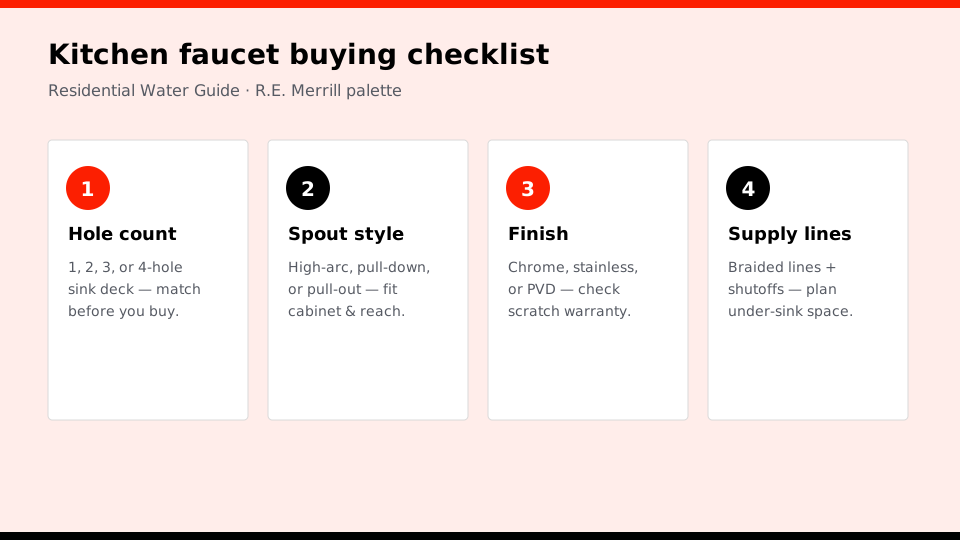
Check these before you shop
- Hole count: one, two, three, or four holes in the sink or counter. A one-hole faucet can cover three holes with a deck plate (escutcheon); extra holes can hold a side sprayer, soap dispenser, or air gap.
- Clearance: distance to a window sill or upper cabinet for tall gooseneck spouts, and room behind the sink for the handle to swing fully.
- Sink size: spout reach should land water near the center of the bowl, especially on double-bowl sinks.
- Shutoffs and supply lines: old multi-turn stops that do not close are a reason to replace them first — see supply lines and shutoff valves.
- Counter thickness: very thick stone or butcher-block tops may need a longer mounting shank.
Spout and sprayer styles
| Style | Good for | Trade-offs |
|---|---|---|
| Pull-down | Deep single-bowl sinks; filling tall pots | Tall spout needs clearance; hose and weight wear over time |
| Pull-out | Shallow sinks and tight spaces; longer hose reach | Shorter spout, so less room under it |
| Standard spout + side sprayer | Simple, low cost, easy parts | Side sprayers often have weaker pressure |
| Commercial-style (spring coil) | Heavy rinsing | Large and visually dominant; needs height |
| Bridge or wall-mount | Traditional looks, farmhouse sinks | Specific hole spacing or in-wall plumbing; usually a plumber job |
| Touch or touchless | Messy hands, frequent cooks | Batteries or power, and more parts to fail |
What is inside matters
- Ceramic-disc cartridges are the norm in quality faucets and resist drips. Brands that sell replacement cartridges and parts make future repairs simple.
- Body material: solid brass or stainless bodies generally outlast plastic-bodied faucets. Waterways may be plastic either way — that is normal.
- Hard water: rub-clean spray nozzles and a removable aerator help with scale; see salt-based vs salt-free softening if scale is heavy.
- Flow rate: federal rules cap kitchen faucets at 2.2 gallons per minute at 60 psi, and some states set lower limits. Many sprayers add a boost or pause mode.
- Certifications: look for lead-free compliance to NSF/ANSI 61 and 372 in the listing.
Finishes
Stainless and brushed nickel hide water spots best. Matte black and brushed gold look sharp but show hard-water spots; polished chrome is easy to clean but shows fingerprints. A PVD finish is generally more scratch-resistant than a plain plated one.
Installation basics
- Shut off both supply valves and open the old faucet to relieve pressure.
- Disconnect supply lines and the sprayer hose; remove mounting nuts (a basin wrench helps).
- Clean the deck, then set the new faucet with its gasket or deck plate.
- Attach new supply lines if they are not included; hand-tight plus the turn the maker specifies.
- Install the pull-down weight per the instructions so the hose retracts cleanly.
- Remove the aerator, flush the lines, reinstall it, and check for leaks for a day.
When to call a pro
- Shutoffs that will not close, corroded fittings, or no shutoffs at all — a licensed plumber.
- Wall-mount, bridge, or pot-filler installs that need new pipe — a licensed plumber.
- Adding a dishwasher air gap, reverse osmosis faucet, or instant hot unit — a licensed plumber and, for power, an electrician.
Start with a licensed plumber for anything that involves cutting pipe, opening a wall, or work your local code requires a permit for. R.E. Merrill & Associates has handled industrial and municipal pumps and fluid systems since 1987 — contact R.E. Merrill & Associates.
Related across the site
- Kitchen cold-water bypass — whether the kitchen cold tap should skip the softener
- Under-sink RO for drinking water — a separate drinking faucet on the sink
Sources
- U.S. Department of Energy plumbing product standards (faucet flow limits).
- NSF/ANSI 61 and 372 drinking-water component and lead-content standards.
- Faucet manufacturer installation instructions; check your local plumbing code.